


Table of Contents
Speak with us today!
Get in touchIf you ask anyone who has to create a monthly B-300 report what the most tedious part of their job is, and you'll hear a lot of muttering about excise duty calculations. If you're a licensed producer with a cannabis processing license, you already know that Canadian cannabis excise duty is one of the more painful parts of running a licensed operation.
Despite everyone agreeing that over-taxation is strangling licensed producers, you still have to calculate & report your excise duties, so... wouldn’t it be nice if your seed-to-sale compliance software could make that easier?
Well, we’re happy to announce that we’ve done exactly that! We’ve just released our long-awaited Automated Excise Duty Calculator. This is, hands down, the single most-requested feature our customers have been asking for.
Here's what you need to know:
CertiCraft’s Automated Excise Duty Calculation
All three types of excise duty are now automatically calculated and displayed in CertiCraft:
- Cannabis Duty
- Additional Cannabis Duty
- Adjustment to the Additional Cannabis Duty
CertiCraft will automatically calculate using both the Flat-Rate and Ad Valorem methods that the CRA requires, and pick the appropriate method for each duty.
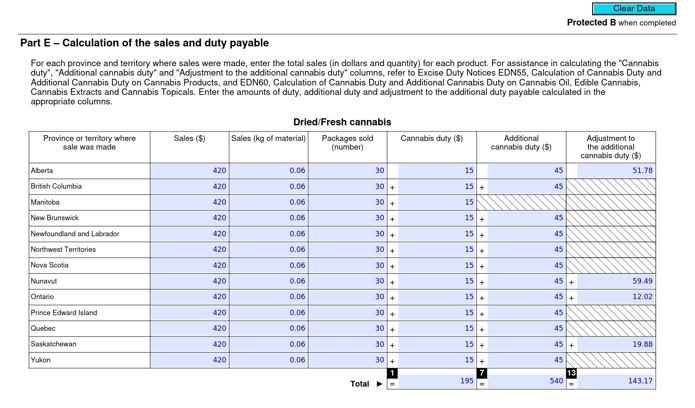
Now, as soon as you add a case or stamped package to an invoice, your excise duty is instantly calculated and displayed. When you generate your B-300, the entirety of “Part E — Calculation of the sales and duty payable” is filled out for you. We’re also happy to report that this update extends automated excise calculation to medical sales as well.

But Wait… There’s More!
Since we at CertiCraft are known for making things easy, we’ve taken things a step further. We’ve given you the option to define your prices in a couple different ways to exactly match how you think of your pricing. Our system will automatically calculate the appropriate excise duty either way.
The two pricing types are:
- Excise Inclusive Pricing: The excise duty is baked into the price you set. If you're selling a case of 12 packages at $120, and $12 of that is excise duty, you set the price per package at $10. This means that $1 per-package excise is included in that $10. The sum of all prices on your invoice will match the Taxable Subtotal in the Order Summary. This pricing type is the default that the CRA assumes and uses throughout their Excise Duty Memorandum.
- Producer Revenue Pricing: In this alternate pricing type that we’ve introduced, the price you set represents the money that you actually make. The excise duty that you need to remit is calculated as if it were a tax on top of the revenue that your company will receive. Using the same example as above, you'd set the price per package at $9, and the $1 excise is added on top. The total price on your invoice will match the Producer Revenue value in the Order Summary.

For medical sales, the price the patient pays will always be set to Excise Inclusive Pricing. Just keep in mind that you’ll need to manually enable the automation in your medical sales settings.
No matter which pricing type you select, you'll see the same Order Summary on every invoice.
The choice comes down to how you think about your pricing: are you setting what you charge your customer, or the revenue you actually keep after duties?
Here’s What Else You Need To Know
As with any major feature update, a few questions popped up during QA for the automated excise duty upgrade. Here are a few helpful bits of intel to help you roll into the next B300 as seamlessly as possible:
It plays nicely with default pricing.
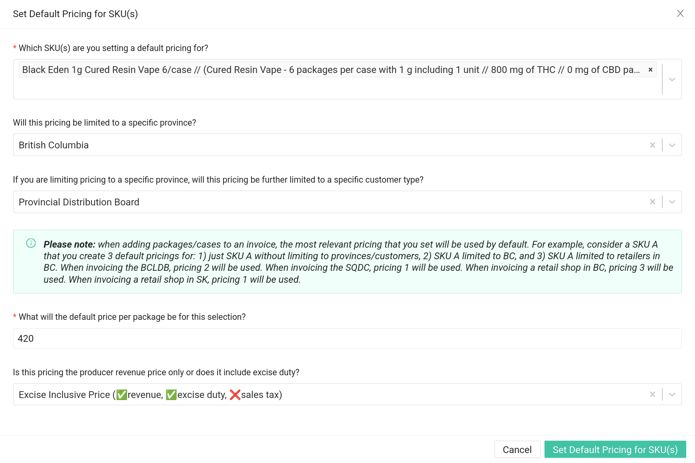
The updates work well with default pricing for SKUs. You can update any default price for any SKU with either pricing type, and you can even mix pricing types across your defaults. But a consistent approach across the board is probably the easiest way to go.
Update everything all at once.
If you want to bring all your defaults in line with a single pricing type, we've added a helper command called Set Pricing Type for All Default Pricings that does so in a single step.
What about things like sending retention samples?
For non-monetary transfers, you'll now be asked to provide a Fair Market Value per package. The CRA requires this to accurately calculate excise duty when no money is changing hands.
If you have additional questions about how the excise duties are calculated, check out the CRA memorandum on cannabis excise duty.
Automated Excise Duty Calculation Means Your B300 Just Got Easier
No matter how much LPs want to see changes to the excise duty model, it’s likely not going anywhere anytime soon. But at least with the new automated exercise calculation, the most tedious part just got a whole lot easier.
And that’s not all we’ve been up to recently! If you want to see what else we've been building, check out our recent update on formulated product manufacturing—another major milestone for CertiCraft over the past year.